How to Check Website Traffic: Free Tools, Metrics, and Competitor Analysis
Website traffic analysis is a critical component of digital strategy, allowing business owners and marketers to evaluate online presence and understand audience behavior. While site owners rely on private analytics platforms like Google Analytics, third-party tools provide estimated data for researching competitors. This guide outlines the essential metrics, methodologies, and free resources available for assessing website performance.
Website traffic serves as a primary indicator of an online entity’s visibility and reach. For business operators, blog managers, digital marketing professionals, and those planning new web projects, understanding how to measure this traffic is essential for making informed strategic decisions.
Traffic analysis provides data on the volume of visits a site receives, the origins of its visitors, the search terms that drive them there, and the geographical distribution of its audience. However, the methods for checking traffic differ significantly depending on whether the user owns the website or is analyzing a competitor’s domain. While owners have access to private, first-party analytics data, third-party tools are required to estimate traffic for other domains.
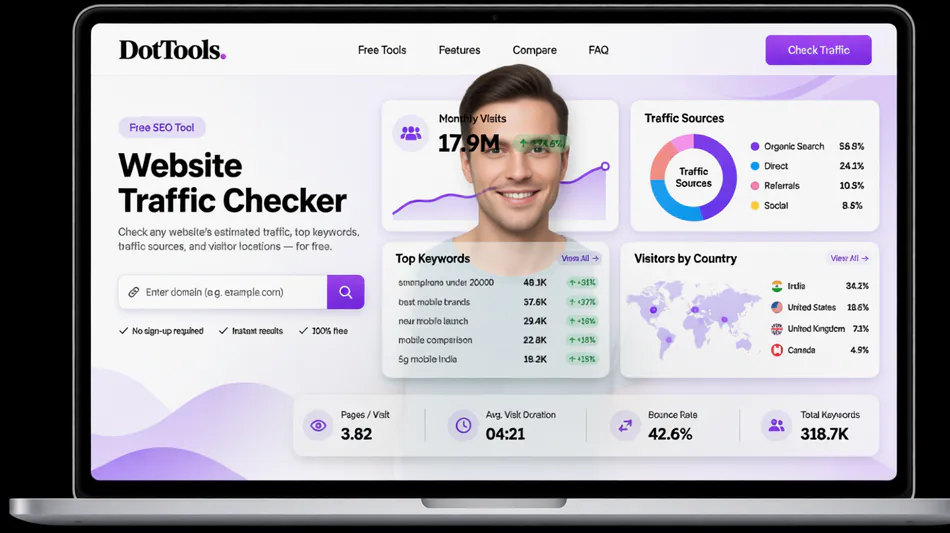
A free website traffic checker offers one of the simplest entry points for exploring another website’s estimated performance. Tools such as DotTools provide online interfaces where users can enter a domain name to examine available traffic information without creating an account. This approach is particularly useful for obtaining a quick overview of a site’s digital footprint without the setup time required for comprehensive analytics platforms.
For website owners, Google Analytics remains the widely used platform for measuring activity. By integrating this tool with their sites, owners can collect detailed information about visitors, sessions, page views, acquisition channels, and user engagement. Unlike third-party estimation tools, Google Analytics provides first-party measurement data from the specific website where it is installed. It is particularly effective for understanding how visitors interact with one’s own content.
However, a Google Analytics account cannot be used to access the private traffic reports of another company’s website. For this reason, researchers must rely on external estimation platforms when conducting competitor analysis.
Google Search Console complements analytics by helping owners understand how their pages perform specifically within Google Search results. It is especially valuable for assessing organic search performance. For instance, if a site shows high impression counts but low click-through rates, the owner might improve page titles and meta descriptions to increase engagement. However, Search Console does not provide complete traffic data from all sources, such as social media or direct referrals.
Several specialized SEO platforms offer robust website research and competitive analysis features. Tools such as Semrush, Similarweb, and Ahrefs provide varying approaches to analyzing website performance. Depending on the subscription level, these platforms may offer estimated visits, organic search traffic volumes, keyword rankings, referring domains, and competitor comparisons. These resources are often utilized by businesses and marketing professionals who require deeper research capabilities than free checkers provide.
Competitor traffic research allows businesses to understand how rival websites attract visitors. Before launching a product, starting a blog, or entering a new market, examining competing sites can reveal valuable insights into their online visibility. The process typically involves identifying three to five competitors in the same industry and comparing their available traffic information using the same tool to ensure consistency.
Such comparisons can reveal differences in audience size, search visibility, and traffic acquisition channels. For example, a competitor receiving significant organic search traffic may have invested heavily in search engine optimization (SEO), while another might depend more on social media or referral sources. It is important to note that estimated traffic data does not reveal a competitor’s revenue, customer numbers, or conversion rates. Knowing the volume of visits is only part of the picture.
To fully assess performance, one must understand the specific metrics involved. Monthly visits indicate the estimated or measured number of visits a website receives over a month. This metric is useful for comparing websites and understanding broad differences in online audience activity. However, monthly visits should not be confused with unique visitors, which count individual users rather than total sessions.
Traffic sources explain how people discover a website. The main categories include:
- Organic search: Visitors arriving through unpaid search engine results. - Direct traffic: Visitors accessing the website directly or through sources where referring information is unavailable. - Social traffic: Visitors arriving through social media platforms. - Referral traffic: Visitors following links from other websites. - Paid traffic: Visitors arriving through paid advertising campaigns.
Understanding these channels helps businesses identify where their online visibility originates and where to focus acquisition efforts.
Search keywords are the terms people use when looking for information, products, or services. Analyzing the keywords associated with a website reveals the topics that contribute to its search visibility. For example, a technology website might attract visitors through searches related to cybersecurity, software reviews, hosting services, or technology news. This information helps content creators identify relevant subjects for future articles.
Geographical data helps businesses understand where their online audiences are located. A website serving customers in India may have a different audience distribution than one targeting the United States or Europe. Understanding visitor locations can inform decisions regarding regional content, marketing campaigns, and product availability.
Checking traffic is only the first step; using the information to improve one’s own website is the ultimate goal. Strategies include creating content that answers questions people are actively searching for, researching relevant keywords, and publishing informative articles that provide practical value. It is advisable to avoid producing multiple pages with nearly identical content simply to target different keyword variations.
SEO helps search engines understand a website and its content. Focus should be placed on descriptive page titles, useful headings, internal links, mobile responsiveness, website performance, and relevant content. Ensuring that important pages are accessible to search engines and included in the sitemap is also critical.
Backlinks, which are links from other websites pointing to one’s pages, play a significant role in authority. Relevant links from established publications, industry websites, and useful resources can help improve a website’s authority and search visibility. Prioritizing genuine editorial links is recommended over purchasing large quantities of unrelated backlinks.
Diversification is also key. Businesses should not depend entirely on one acquisition channel. Exploring opportunities across organic search, social media, newsletters, referral partnerships, and other channels relevant to the audience can build a more resilient strategy. Using analytics data to understand which channels bring valuable visitors allows for more effective resource allocation.
Regular performance checks are necessary. Comparing results over several months, rather than making decisions based on a single traffic report, makes it easier to identify meaningful changes and evaluate the results of marketing activities.
While traffic checkers and analytics platforms are related, they serve different purposes. A traffic checker is generally more suitable for preliminary competitor research, while an analytics platform is better for measuring the actual activity of a website one controls. Using both approaches can provide a more complete understanding of online performance.
However, website traffic analysis can be misleading if interpreted incorrectly. Third-party traffic tools use different datasets and estimation methods, meaning their results may differ significantly from one another. Comparing estimates from separate platforms may not yield directly comparable data; using the same tool for multiple domains is essential. Additionally, two websites with similar monthly visits may have completely different acquisition strategies. High traffic does not automatically mean high sales or profitability. Finally, a temporary increase in visits does not necessarily indicate sustainable growth.
Understanding these limitations helps users make better decisions using traffic analysis. For competitor research, a third-party website traffic checker can provide estimated traffic information. Tools like DotTools offer free online checkers that allow users to analyze domains and explore available traffic insights without registering an account.
For those who own a website, analytics platforms provide more direct measurements. Some website traffic analysis platforms also provide estimated geographical information, including the countries contributing to a website’s audience. A visit generally represents a browsing session, while a page view represents an individual page being viewed; one visit can include multiple page views.
Knowing how to check website traffic is useful for anyone working with websites, digital marketing, or online businesses. A combination of traffic estimation tools, website analytics, and search performance data can help users understand online visibility, research competitors, and identify opportunities for growth. For those who want to start analyzing websites without a complicated setup, free tools offer an accessible entry point into digital strategy.
S.Esposito--LDdC