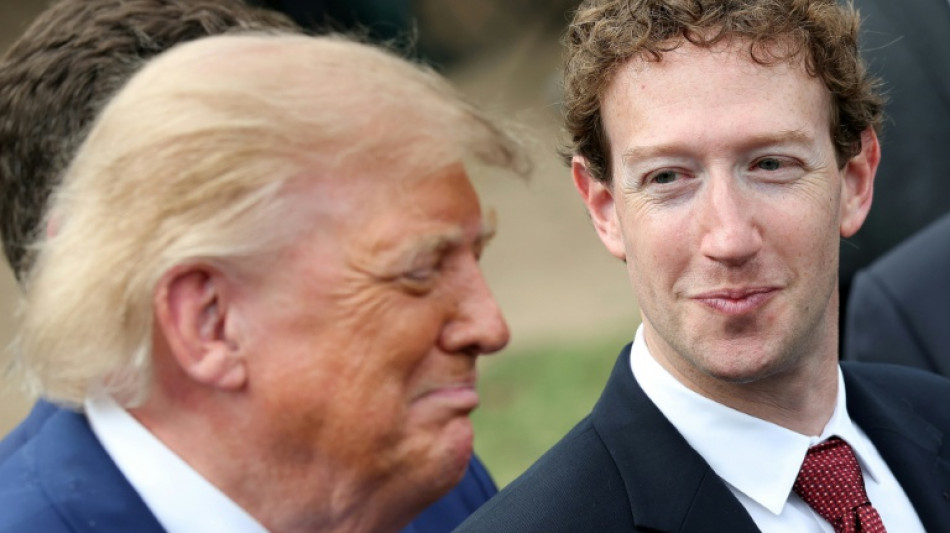
Trump's 'super intelligence' rebrand to sell AI faces uphill battle / Photo: Kevin Dietsch - GETTY IMAGES NORTH AMERICA/AFP
Donald Trump's campaign to rename artificial intelligence as "super intelligence" is unlikely to win over a wary public and could make matters worse, experts say, even as the US president threatens to treat holdouts as enemies.
On Thursday, he warned that anyone refusing to adopt the term would be considered an "ENEMY" by the White House, without saying what that would mean.
He had floated the name change in September before the UN General Assembly, saying it sounded much better.
"The use of the word artificial makes intelligence fake. It makes it sound fake, and it is not fake. It’s actually amazing," he said.
He later signed an executive order mandating the term in government communications.
According to Jean-Pierre Dube, a marketing professor at the University of Chicago, there is a genuine concern at the White House that the backlash against AI and data centers could "stifle one of the key drivers of economic growth right now" and "cede technological dominance to China."
However, "the idea that a re-brand that mis-characterizes the technology will turn around some of the public sentiment seems like wishful thinking," he told AFP.
- 'Poor choice' -
But expert opinion matters little to Trump, who wrote in his book "The Art of the Deal": “I don’t trust fancy marketing surveys. I do my own surveys and draw my own conclusions.”
He even polled users on Truth Social, where "super intelligence" beat out the other option, "superior intelligence."
Americans see Trump as overly enthusiastic about artificial intelligence, which many already use but whose consequences for safety and jobs they fear, while also worrying about the rapid construction of massive data centers.
In a recent Quinnipiac University poll, only 25 percent of voters said they were satisfied with how the 80-year-old Republican is approaching AI, against 58 percent who were dissatisfied.
"If we believe that 'artificial' already encourages fear, 'super' seems like something far more worrisome," said Dube, calling it "a poor choice of new brand."
For Ronald Kline, a historian at Cornell University, "the phrase 'super intelligence' means more than simulating human intelligence, it means going beyond human intelligence," he told AFP.
The term "artificial intelligence" was born in 1956 at an austere summer workshop at Dartmouth College.
Deliberately abstract, it was chosen to bring under one banner the research of scientists from varied backgrounds -- mathematicians, psychologists and engineers driven by the same ambition: teaching computers, at the time enormous calculating machines, to "think" like humans.
Seen by some as a catch-all, the term never won unanimous support from the scientific community, which nonetheless came to accept it -- as did Herbert Simon, winner of the 1978 Nobel Prize in Economics, who wrote as early as 1969: "'artificial intelligence' seems to be here to stay, and it may prove easier to cleanse the phrase than to dispense with it."
For Kline, the name truly took off when it became the acronym AI, associated with the stratospheric growth of companies such as OpenAI.
The ChatGPT maker is not forced to change its name by Trump’s executive order, which applies only to the federal government.
But some of the sector’s top executives have chosen to follow the president, who closely tracks whether his various unilateral name changes are adopted.
The Associated Press news agency drew his wrath for refusing to adopt the name "Gulf of America" in place of "Gulf of Mexico."
The term "super intelligence" has appeared in communications from Meta, Mark Zuckerberg’s group.
Elon Musk, a Trump ally, enthusiastically supports the name change and uses "super intelligence" in his posts on X.
A Washington industry lobbyist interviewed by AFP predicted a pragmatic approach from companies.
"I think you’ll see it used when it has to be used, i.e. when you’re communicating with the administration," he said. "Insisting on 'AI' versus 'super intelligence' isn't a fight you need to pick."
F.dGiugiaro--LDdC