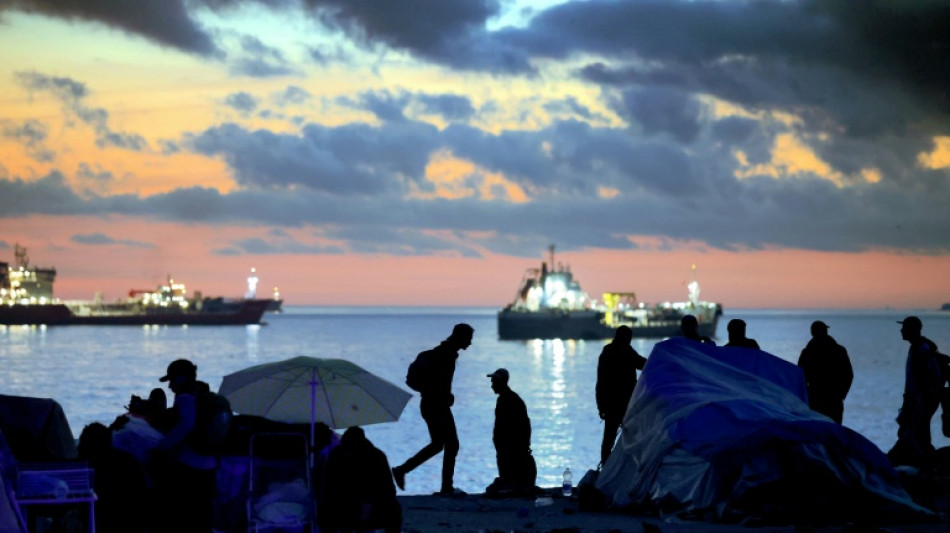
EU seeks deportation powers for beefed up border agency / Photo: Thomas COEX - AFP/File
The European Union wants to give its border agency greater powers, including handling deportations, under plans to strengthen the bloc's response to irregular migration presented on Tuesday.
The reform plan is the latest attempt to tackle irregular migration amid a souring of public opinion that has fuelled far-right electoral gains across Europe.
The European Commission proposed giving the Frontex agency a central role in arranging the expulsion of people with no right to stay in the EU and to create a 17,000-strong "reserve" of officers ready to be deployed when needed.
"Europe will always stand up for the protection of its borders. Europe decides who comes to our Union and under what circumstances," EU chief Ursula von der Leyen said.
Under the plan, Frontex's "standing corps" will triple to around 30,000.
The number includes 17,000 officers who will remain with member states as national border guards and only be deployed as part of a new "European border and return reserve" when needed.
In response to the migrant crisis in the Spanish territory of Ceuta this year, the proposal also envisages a "quick reaction force" and a new monitoring centre to scan social media.
Social media disinformation is said to have helped drive a deadly rush of more than 70,000 people who crossed into Ceuta from Morocco in July.
- Returns -
Frontex will also have a bigger role in deportations.
A new centre would help EU countries plan and coordinate expulsions.
The agency will support member states "from early identification and voluntary return counselling to carrying out return operations and providing reintegration assistance", Brussels said.
The text opens the door for Frontex's involvement in so-called "return-hubs" that a handful of EU countries are seeking to set up outside the bloc.
Allowed by another recent reform, these would serve either as the final destination or as transfer centres for those expelled. Supporters of the centres say they would act as a deterrent for would-be irregular migrants.
Denmark, Austria, Greece, Germany and the Netherlands are working to have one centre running in 2027 -- with Rwanda tipped as the likely host country.
"Frontex will be able to help organising and carrying out return operations from one third country to another," Brussels said.
The agency was created in 2004 to patrol the Schengen visa-free travel area's external borders, fight cross-border crime and manage migratory flows. Its mandate was first expanded after a 2015 migration crisis when more than one million people arrived in Europe.
It is frequently criticised by migrant rights groups who accuse it of engaging in the illegal "pushback" of migrants.
"In the face of mounting human tragedies, the response remains the same: ever-increasing repression, the continued dehumanisation of displaced people, and an ever-greater tendency to mirror the rhetoric of the far right," Green EU lawmaker Melissa Camara said of the latest reform proposal.
Migrant arrivals have fallen in recent years.
This month Frontex reported that irregular border crossings were down by almost one-third in the first nine months of 2026 compared with the same period last year, but migration remains a hot button issue across Europe.
S.dEsposito--LDdC