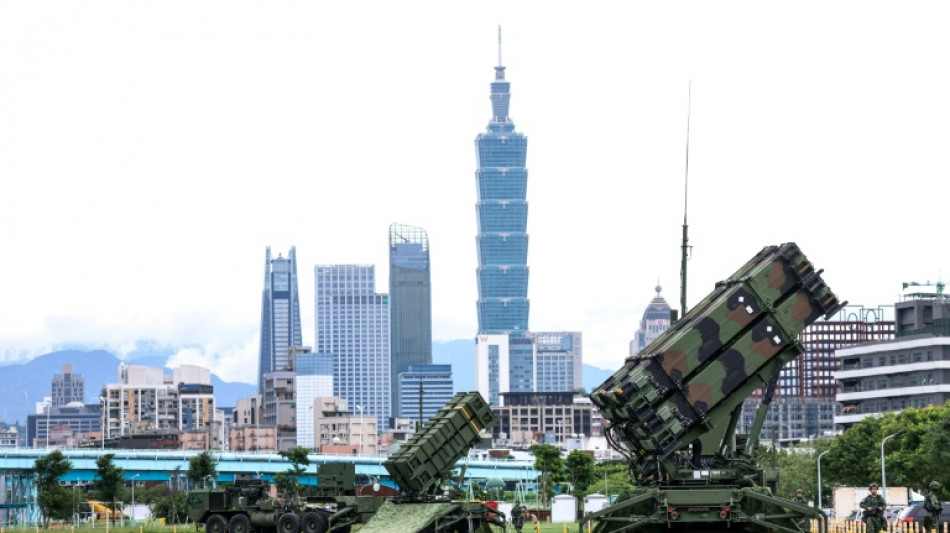
What's holding up Washington's $14 bn arms sale to Taiwan? / Photo: I-Hwa Cheng - AFP/File
Taiwan has been waiting months for US President Donald Trump to approve a $14 billion sale of weapons and equipment, which the island democracy would use to fend off a potential Chinese attack.
Washington -- Taipei's most important security backer -- has sold many billions of dollars' worth of arms to Taiwan, most recently in December when it approved a record $11.1 billion package.
China opposes American military support for Taiwan, which Beijing claims is part of its territory and has threatened to seize with force.
Trump, who last month hailed his "great friendship" with Chinese President Xi Jinping, has resisted US political pressure, including from Republican lawmakers, to give the green light for the current arms package.
AFP takes a look at what's in it and why it's being held up:
- Why is Taiwan buying US arms? -
Taiwan is spending huge sums upgrading its defence capabilities and expanding its domestic weapons production capacity, but it still needs US arms to deter China.
Since Washington switched diplomatic recognition from Taipei to Beijing in 1979, the United States has stuck to its commitments under the Taiwan Relations Act to provide weapons to Taiwan for its defence.
But Trump said in May that US arms sales to Taiwan could be a bargaining chip with China, setting off alarm bells across the world.
Taipei has reminded Trump of US commitments, and US officials including Secretary of State Marco Rubio have insisted American policy on Taiwan has not changed.
The sale would signal US support for Taiwan and send a message to Beijing that if it launched an attack, it would not face "Taiwan alone", said Wang Ting-yu, a senior lawmaker in President Lai Ching-te's Democratic Progressive Party.
- What's in the package? -
Taiwan is developing a multi-layered air defence system, known as the T-Dome, that it hopes could counter a potential Chinese attack.
Patriot missiles, an automated command and control system and a 360-degree air defence radar system are seen as critical components of this system and are among the items in the $14 billion package.
"Together these systems can strengthen the resilience of Taiwan's strategic air defences," said Su Tzu-yun, a military expert at the Taipei-based Institute for National Defense and Security Research.
Money for the weapons system is expected to come from a $25 billion defence spending bill passed by Taiwan's parliament in May after months of political wrangling.
- Why has it been delayed? -
Trump and Xi met in Beijing in May -- the first of four expected meetings for 2026 -- as the rival leaders sought to ease trade tensions between their countries.
Xi issued a blunt warning to Trump that missteps on Taiwan could push the US and China into "conflict".
A record $14 billion arms sale to Taiwan could threaten the US-China trade truce.
"I'm going to make a determination. I'm going to see," Trump said after the summit in response to a question about whether he would go ahead with arms sales to Taiwan.
Rubio said in June that the proposed package was "under review", while officials said in May they were assessing whether American weapons stockpiles were sufficient for its Iran operations.
A US official said recently that the chances of the package being split into smaller chunks "have gone way up".
Some Taiwanese officials have said they do not care if the US bundles the arms into a single package or multiple -- they just want the weapons.
"Militarily... Taiwan is racing against time," said the analyst Su.
"Acquiring weapons is not like ordering at a drive-through. Production, delivery and training all take time before the systems can enter service and become effective."
M.Vecchiarelli--LDdC