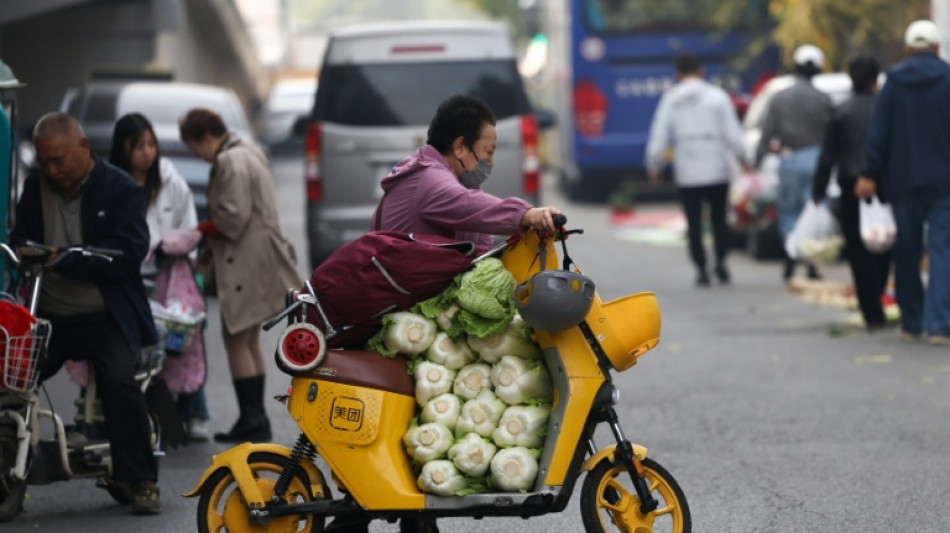
China's third-quarter growth narrowly beats forecasts / Photo: - - CN-STR/AFP
China's economy grew slightly more than expected in the third quarter, but Monday's figures still came in at the lower end of the government's full-year target, as the global energy shock and weak domestic demand counter surging exports.
The world's second-largest economy has charted a diverging path in recent years, with an AI-fuelled export boom masking the impact of a persistent real estate crisis and gloomy consumer sentiment.
Gross domestic product expanded 4.5 percent in July-September, according to the National Bureau of Statistics.
The reading was an improvement on the previous quarter's 4.3 percent expansion and just ahead of the 4.4 percent predicted in an AFP poll of economists.
Beijing is hoping for annual growth this year of 4.5-5.0 percent, its lowest goal in decades.
NBS deputy head Mao Shengyong described the international context as "complex and volatile" during a news conference following the data's publication.
He added that domestic demand was "insufficient".
In late September, Beijing rolled out mortgage subsidies for certain home purchases and support for infrastructure investment, seeking targeted boosts for the economy as activity flagged.
While consumer activity has been a drag this year, separate data Monday showed retail sales rose 1.1 percent last month, the fastest pace since March.
However, Zhiwei Zhang, chief economist at Pinpoint Asset Management, said economic momentum remained "subdued" in September.
"After adjusting for inflation, real retail sales barely grew compared to one year ago," he wrote.
He added that the better-than-expected GDP numbers could dissuade the government from enacting "significant" policy shifts in the fourth quarter to achieve annual targets.
Industrial production grew 5.5 percent year-on-year in September, the NBS also said Monday, up from 5.2 percent the previous month.
That increase was "helped by strong foreign demand", wrote Nguyen Hoang Nam of Capital Economics.
- 'Rebalancing' needed -
But fixed-asset investment sank 7.2 percent during the first nine months of the year combined, the data showed.
China, the world's largest importer of crude, is under pressure from the high cost of energy caused by the Iran war, which has stymied shipping from the oil-rich Gulf.
Higher energy prices and "protracted uncertainty and structural headwinds" led the International Monetary Fund to last week slightly downgrade its projection for China's annual growth this year to 4.5 percent.
Economists say China's economy must shift towards a growth model powered more by domestic consumption than traditional drivers like construction, property development and exports.
That long-awaited "rebalancing" of the Chinese economy has yet to materialise, the IMF's Asia and Pacific department director, Krishna Srinivasan, said at a press conference in Bangkok last week.
Exports -- for decades the engine of China's economy -- remain a bright spot.
Figures released last week showed a surge in overseas shipments put the country on course for another record trade surplus that would top last year's $1.2 trillion.
That export boom has been underpinned in large part by insatiable global demand for AI-related products including computers, semiconductors and data centre equipment.
But elsewhere, China's soaring surpluses are stoking tensions with key trading partners, including the European Union and the United States.
Talks this month between EU trade chief Maros Sefcovic and Chinese counterpart Wang Wentao ended with an agreement to limit exports of Chinese hybrid vehicles to Europe.
Many critics contend that Beijing's extensive subsidies doled out in recent years to domestic industries have given them an unfair advantage in foreign markets.
Domestic demand woes have also exacerbated the problem, as manufacturers increasingly look overseas for new growth.
G.Tomaselli--LDdC