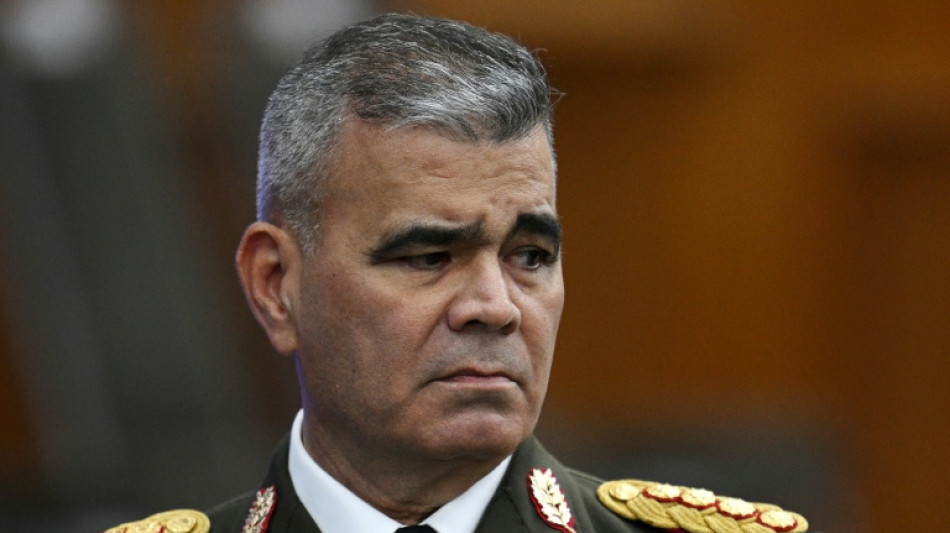
Vladimir Padrino: Venezuela's military power broker / Photo: Federico PARRA - AFP/File
Vladimir Padrino, the man who wields absolute control over Venezuela's powerful military, became a soldier entirely by chance.
Named by his father after Marxist revolutionary Vladimir Lenin, Padrino was a high school pupil when a friend asked him to tag along to a Military Academy entrance exam.
He told the friend he was "crazy," Padrino, now 62, recalled in a 2021 interview with state channel VTV.
"I ended up going with him, took the exam. My friend didn’t get in and I did."
It would change the course of his life -- ultimately leading to his position as a key powerbroker in Venezuela.
His support will prove critical for the nation's interim leader Delcy Rodriguez who took the reins this month after the US military operation that ousted Nicolas Maduro.
Padrino's regime credentials are unparalleled. As a cadet soldier decades ago, Padrino met a lieutenant Hugo Chavez, who would later become Venezuela's larger-than-life president.
"After I met Commander Chavez, the revolutionary seed took root," Padrino has said about the now-deceased socialist leader whose presence continues to loom large over the South American country and whose decisions are blamed for the start of its economic collapse.
"He was my teacher, my mentor," Padrino said.
A decision in 2002 catapulted his career as a key enforcer for the so-called Chavista regime.
When the military launched an ultimately unsuccessful coup that year that ousted Chavez for only 48 hours, Padrino -- then commander of an important battalion -- did not take part.
The then-president had urged him on the phone: "Padrino, please, don’t let brothers kill each other. Padrino, please, stay in your barracks," the general has since recounted.
He obeyed and after the coup was quashed, the then-lieutenant colonel began a steady series of successive promotions.
- 'Absolute loyalty' -
Padrino, a father of two who loves traditional Venezuelan music and classic literature, has been under US sanctions for years for alleged drug trafficking, rights abuses and corruption.
After Chavez's death in 2013, his hand-picked successor Maduro took over as president and the new face of the Chavista movement.
Padrino, then serving as chief of the army general staff, became defense minister and Venezuela's highest-ranked officer the following year.
The general was key to cultivating a culture of "absolute loyalty" in the military -- which defended Maduro's widely disputed claim to reelection in July 2024 by overseeing a crackdown on protests that resulted in thousands of arrests.
"He was Maduro’s face within the Armed Forces," said Hebert Garcia, a retired general who served as a minister in Maduro's government until breaking ties with the regime and going into exile.
"He... guarantees control of the Armed Forces" by the government, Garcia told AFP.
After Maduro's toppling on January 3 in a US military strike that killed dozens, Padrino shifted that loyalty to interim leader Rodriguez.
Without the backing of the military, Rodriguez stands no chance.
It controls mining, oil and food distribution companies, as well as the customs authority and Venezuela's volunteer "colectivos" -- armed loyalists of the leftist leadership.
As defense minister, Padrino also has authority over all other government ministries -- many run by current or former military men.
- Rodriguez 'in danger' -
Since taking office for a six-month interim stint as stand-in president, Rodriguez has avoided making changes to the military high command.
She kept Padrino and Domingo Hernandez Larez -- the head of Venezuela's Strategic Operational Command in charge of troop deployment.
Rodriguez did, however, replace the head of her presidential guard -- who also led the counterintelligence agency -- and changed the generals in charge of 12 of the military's 28 regional commands.
Garcia believes Padrino's support for Rodriguez may not last if Trump decides he is no longer willing to work with her.
Yet her very cooperation with Washington challenges the "anti-imperialist" character of the military that Padrino has cultivated.
Rodriguez's grip on power is "in danger," a diplomatic source told AFP on condition of anonymity, adding: "She does not control the security forces" as Maduro did via Padrino.
R.DeCrescenzo--LDdC