'Not our enemy': Rush to rearm sparks backlash in east Germany / Photo: Ina FASSBENDER - AFP
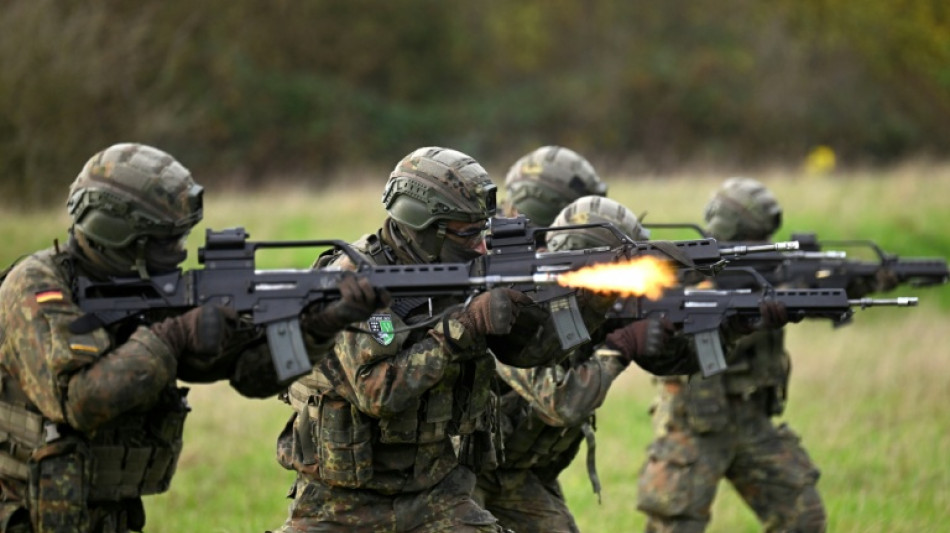
As Germany faces a hostile Russia, a defence firm plans to open a munitions plant in the ex-communist east -- but many locals are sympathetic towards Moscow and up in arms about the project.
Opposition has mounted to the business venture in the town of Luebben, Brandenburg state, despite the promise of hundreds of jobs in the economically depressed region.
An anti-war poster on the streets reflects the fears of many, showing a soldier holding a fallen comrade in his arms.
It was put up by the local initiative "Our Luebben" to protest against plans by the arms group Diehl to soon start producing munitions components at the factory.
German leaders often warn of Russia's war in Ukraine and its threats against European NATO members.
But at a monthly meeting of the citizens' group, mention of the "Russian threat" was met with loud laughter.
"Russia is not our enemy! Russians lived here for years," said Manuela Noack, a 62-year-old nurse, harking back to the Soviet presence in communist East Germany.
The group has collected around 1,600 signatures -- in a town of 14,000 people -- against the plant, which is expected to be running at full capacity by 2027.
Nancy Schendlinger, the group's founder, argues that around 80 percent of residents are opposed to German Chancellor Friedrich Merz's push to make the Bundeswehr the largest conventional army in Europe.
Merz says that more spending on defence is an urgent priority given Russia's invasion of Ukraine and US President Donald Trump's questioning of transatlantic security ties.
- Divided community -
"We've already lived through this," Schendlinger told AFP, referring to the Cold War arms race.
That led to a "spiral of militarisation in both East and West, and in the end our pockets were empty," said the 54-year-old tax advisor.
She said she hopes to never see her 15-year-old son carrying a weapon.
The far-right, anti-immigration Alternative for Germany (AfD), which advocates buying Russian energy and general detente with Moscow, won 39 percent of the vote in Luebben in February's general election.
That was almost twice the party's national score and 17 points ahead of Merz's centre-right CDU/CSU alliance.
While the local AfD supports the factory, it has backed "Our Luebben" on other issues, such as its 2023 campaign against the construction of a reception centre for migrants.
The AfD and CDU may be poles apart on Russia, but they agree that arms production is good for the region, especially as the factory is expected to create around 200 jobs.
The factory site has a long military tradition, having made equipment for the Nazi army, then cartridges for the communist regime.
After German reunification, unused munitions there were destroyed.
CDU mayor Jens Richter says he "understands" the divisions in the community over the factory, but says that Russia's invasion of Ukraine means "the geopolitical situation has changed significantly".
Marko Schmidt, from the local branch of the AfD, says he has no problem with weapons being made "for the defence of Germany" -- but not to send to Ukraine.
- 'We should shut up' -
Despite German political and security chiefs regularly accusing Moscow of acts of "hybrid warfare", Schmidt says "our government is completely overreacting".
"Russia will never attack Europe, or at least not Germany," he told AFP, adding that if there were to be a conflict, Europe would be to blame.
For now, the factory in Luebben is something of an exception in eastern Germany, with 90 percent of the defence industry still based in the west.
In 2023, the arms group Rheinmetall had to abandon plans to build a factory in Saxony, another eastern state, in the face of protests.
Diehl declined to give an interview to AFP but said in a statement that it is "seeking dialogue" with residents over their concerns.
At the monthly meeting of "Our Luebben", townspeople voiced strong doubts that Russia today spells a threat.
"What would they even come to Germany for?" asked Andre Hannemann, a 60-year-old railway worker.
Thomas Fischer, a 75-year-old retired airforce member, invoked Germany's dark past to explain his opposition to rearmament.
"We Germans should shut up," he said. "We started two world wars. We should show restraint."
H.Nicolini--LDdC