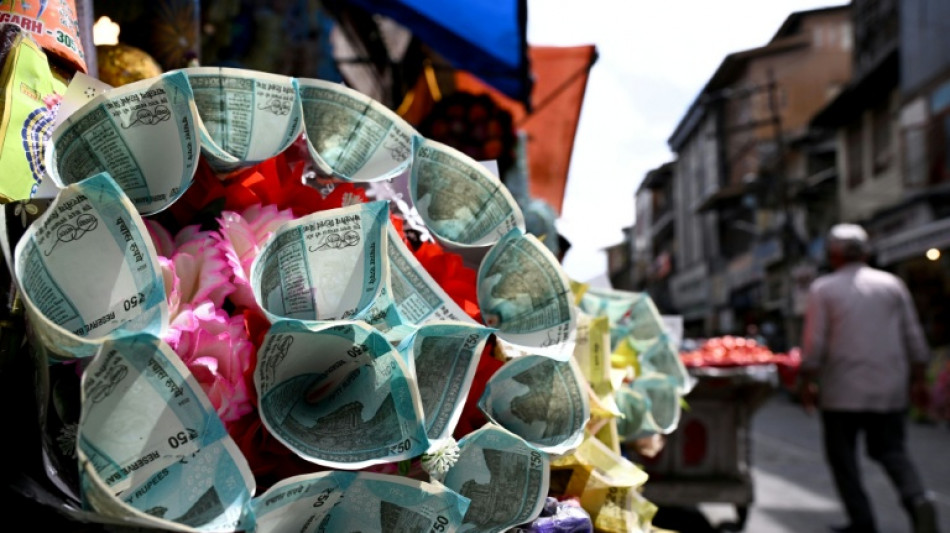
India scrambles to steady rupee as oil shock bites / Photo: Tauseef MUSTAFA - AFP
India is scrambling to salvage a sinking rupee as surging oil prices linked to the Middle East conflict threaten to disrupt the world's fastest-growing major economy.
The currency has dropped more than five percent since the crisis erupted in February, extending losses from 2025 and making it Asia's worst-performing major currency in 2026 so far.
It hit a record low of over 96 to the dollar on Friday, prompting officials to signal that halting further depreciation is a key macroeconomic priority.
India's central bank has already poured billions of dollars to stabilise the currency, curbed speculative trading and offered a special credit line to oil importers to ease dollar demand.
Prime Minister Narendra Modi has also urged voluntary austerity measures to rein in dollar-guzzling imports, including cutting down on gold buying and foreign travel for a year.
But the pressure persists.
"The whole system has been disturbed," said Dilip Parmar of stockbroker HDFC Securities, citing heavy foreign investor outflows, weaker growth prospects and elevated crude prices.
"That is the basic problem which you're seeing replicated in the fall of the rupee," he said, noting that it was ultimately "a function of demand and supply" with dollar demand being higher.
The rupee's slide comes as India faces a widening current account deficit driven by costly energy imports.
The gap is likely to be over two percent of GDP this fiscal year, more than double last year's level and potentially the widest since 2012–13, according to Bank of America Securities estimates.
- Widening deficit -
At the same time, foreign investors have dumped more than $20 billion in Indian stocks since the start of the Mideast conflict, the fastest pace on record, while dollar inflows have slowed, opening the possibility of a balance-of-payments gap as large as $67–88 billion.
The 2027 fiscal year "will be our third year of a balance-of-payment deficit, which is certainly unusual," economist Dhiraj Nim of ANZ Research told AFP.
This strain has weighed on the rupee, prompting the central bank to defend it by burning through foreign exchange reserves -- now at around $697 billion, down from over $720 billion before the Middle East war.
While still covering about 11 months of imports, the decline underscores the strain.
A weaker rupee is rippling through the domestic economy.
Manufacturers and food processors, many dependent on imported raw materials priced in dollars, are seeing costs surge.
Smaller firms often lack the ability to hedge currency risks.
In Kerala's cashew industry, which mostly imports raw nuts from Africa, the impact has been acute.
"Imports have become far more expensive for the local market," said Rajmohan Pillai, who runs a cashew firm, adding buyers can now afford only about 90 percent of last year's volumes.
He estimates more than 80 percent of processing units have shut in recent years, with rupee volatility a contributing factor.
- 'Last straw' -
India's currency decline has also hit students looking to study abroad.
Education consultants say studying in the United States now costs more than one million rupees ($10,450) extra compared with a year ago.
"This is the last straw," said Meghna Sen, a 17-year-old aspiring psychology student.
"Now we have to track (the rupee) movement to check how much we need for our grocery budgets."
The depreciation has punctured India's ambition to become the world's third-largest economy.
Modi, who once criticised his predecessors over currency weakness, has seen India's global economic ranking dented because GDP comparisons are measured in dollars.
The country has slipped behind the United Kingdom to the sixth place according to IMF data, largely due to the rupee's fall.
Nomura analysts warn more drastic measures may be on the anvil.
These include possible fuel price hikes, tighter controls on overseas remittances and steps to attract dollar deposits from non-resident Indians -- a playbook used in past crises.
Still, economists caution that intervention can only smooth volatility, not reverse underlying pressures.
"Fundamental factors" remain to be resolved, Nim said, adding "I would not even rule out an interest rate hike which squarely targets future inflation".
The Reserve Bank of India knows what its options are, he said.
"All that remains is to see what it decides to choose."
A.Dodaro--LDdC