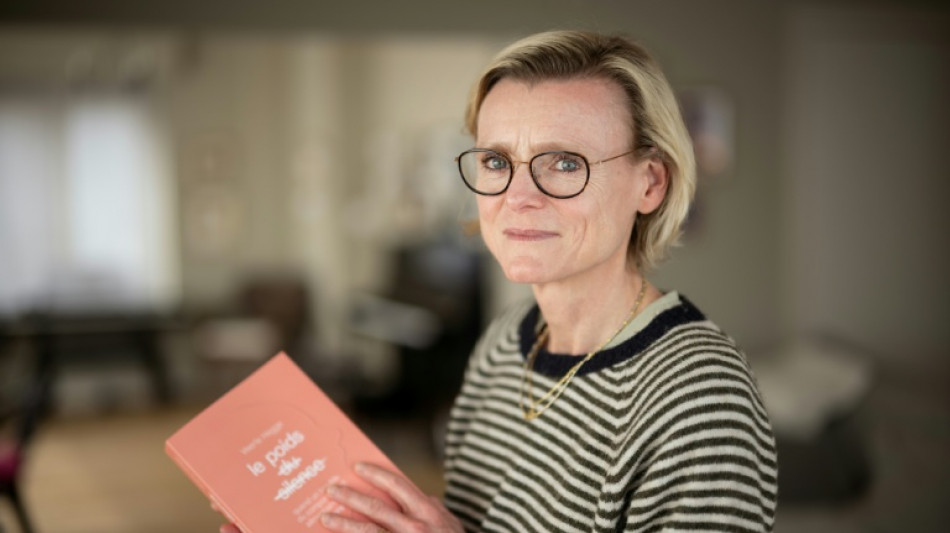
In Belgium, prime minister's wife shares anorexia struggle / Photo: JOHN THYS - AFP
Just weeks after her husband won Belgium's national elections in 2024, Veerle Hegge found herself in hospital for an eating disorder that almost claimed her life.
Nearly two years later -- including six months of full-time treatment -- Prime Minister Bart De Wever's wife shared with AFP why she chose to take her anorexia struggle public in a book that delves deep into her personal life.
"Mental illness is still surrounded by taboo," the 53-year-old schoolteacher said in an interview at her home in the port city of Antwerp. "It's something people feel uneasy, awkward even, to talk about."
"It's so important to get care early on when you are sick," she says, to avoid "falling in deeper."
"But you can only do that with help from the people around you."
Hegge has been De Wever's partner for three decades, through his longtime tenure as mayor of Antwerp and since he became prime minister last year, raising four children now aged 18 to 24.
Entitled "The weight of silence", her book focuses largely on the months she spent in hospital treatment in 2024 -- the time she needed to get back on her feet from a near-fatal battle with anorexia.
A striking scene recounts her hour-long car journey to a clinic in eastern Belgium -- with De Wever in stony silence at the wheel -- after it became clear getting full-time specialist help had become a matter of "survival."
De Wever's Flemish conservatives had just won the national election, and he was tipped for prime minister.
His wife remembers thinking he must be "disappointed" in her -- but not daring to ask. At home, she says, everyone used to "tiptoe around" the matter of her illness.
She describes a "rushed" arrival at the clinic -- and the shock of finding herself alone, with a psychiatric patient tag around her wrist.
"Bart couldn't stay long -- he had to get back to work as always," she writes in the book's opening pages. "We hugged briefly, and agreed to call one another. That was all. And Bart left."
Hegge speaks candidly of her loneliness and guilt at being away from home -- after so many years keeping family life ticking over while De Wever pursued his career -- although soon enough she was able to leave the hospital at weekends.
Later in the book, she writes that her husband had seemed "helpless" faced with her ordeal, and thanks him for sticking by her side.
- Buried trauma -
Much of Hegge's story is devoted to her childhood -- where her earliest memories are dominated by a mother prey to bouts of deep depression, whose fits of anger she grew to fear and second-guess.
Home life was often marred by silence and simmering conflict -- but that was not the hardest part of growing up.
From the age of five or six, she reveals she was sexually abused by an older boy over a period of several years -- a trauma she now realises she repressed until just a few years ago.
"Accepting that truth opened the floodgates," she writes. "It had a huge impact on my body, my sense of internal balance."
"Eighteen months later I was admitted to intensive care for an advanced eating disorder," she says -- the first of two episodes that would culminate with her hospitalisation the year of the election.
Hosting AFP's team in her family living room, in a comfy pullover and sneakers, Hegge says she is doing better.
Since her book hit the shelves -- in French last month, after an initial release in Dutch last year -- she says she has received countless messages of support.
Among those reaching out are people battling eating disorders themselves, or supporting loved ones as they struggle, who thank her for tackling the painful topic head-on.
"Some of the people I see cling on to me, or start to cry," she told AFP. "There is so much pain and suffering."
C.Jacaruso--LDdC