UNESCO recognition inspires hope in Afghan artist's city / Photo: Wakil KOHSAR - AFP
Hundreds of years after the celebrated painter Kamal ud-Din Behzad roamed the streets of Herat, artists in the Afghan city are finding joy and hope in his recognition by UNESCO.
Sitting cross-legged on a red carpet, artist Mohammad Younes Qane uses an ultra-fine paintbrush to trace details such as a horse's mane or the beads of a necklace.
"When I paint, I'm taken back 500 years, to the streets of Herat back then," when the rulers of the Timurid empire were patrons of artists such as Behzad, Qane said with a smile.
Since he was a teenager, the 45-year-old has been practising Behzad's celebrated miniature art style, which inspired French artist Henri Matisse.
A contemporary of Italian masters Leonardo da Vinci and Sandro Botticelli, Behzad brought a new style to Herat before settling in Tabriz, in modern-day Iran.
Celebrating his "vibrant cultural expression", the UN's cultural agency inscribed Behzad's style of miniature art on its list of Intangible Cultural Heritage of Humanity in December.
Such recognition was "truly joyful news", coming "at a time when we are in darkness and facing very difficult conditions", Qane said.
Since the Taliban authorities returned to power in 2021 and imposed their strict interpretation of Islamic law, many artists have left Afghanistan.
Qane has closed his gallery and works at home, with clients now rare and exhibitions non-existent.
He sometimes climbs the hill to a white tomb believed to be Behzad's, where he finds peace.
Taliban officials have banned music in public places, as well as the representation of living things.
- 'Proud of Behzad' -
Numerous residents pointed to the increasing enforcement of the ban on showing human faces, which are a common feature of Behzad-style artworks.
"It's very sad, because we are proud of Behzad in Herat," said one resident, speaking on condition of anonymity for security reasons.
Ahmad Jawid Zargham, the former head of the provincial arts and culture department, said paintings were "simple and without soul" before Behzad.
"He introduced scenes from people's everyday life. For example, ordinary people, passersby, dervishes, mullahs, scenes of teaching girls and boys, or groups of workers busy with architecture," Zargham told AFP.
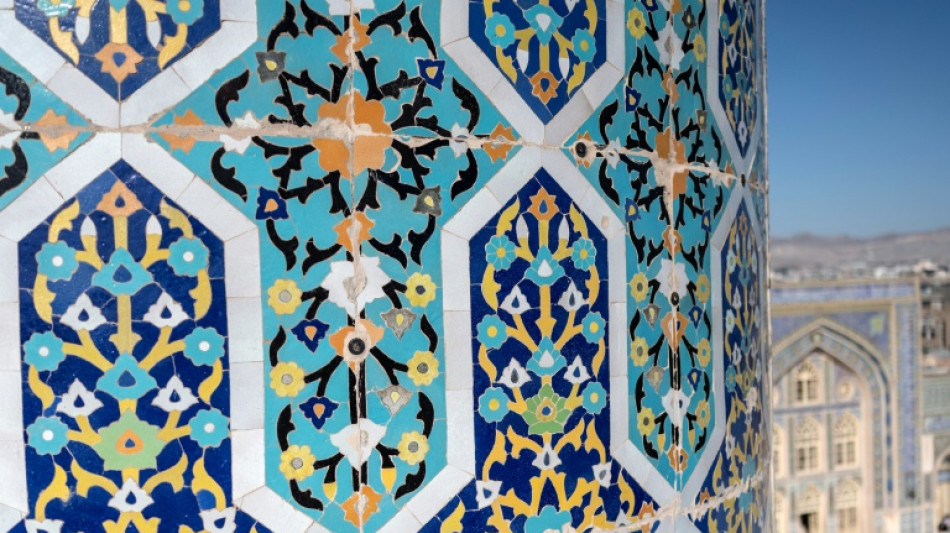
At Herat's central mosque, which is covered in blue ceramic tiles, there are delicate floral and geometric motifs created by Behzad.
But his decorated manuscripts are kept abroad, at world-renowned institutions such as New York's Metropolitan Museum of Art, the British Library in London and the Topkapi Palace Museum in Istanbul.
Michael Barry, a leading specialist in miniature art, said that people being deprived of their cultural patrimony was "the height of injustice".
At the same time, he remained "very aware of the care that is required to maintain these delicate works", which can easily be damaged by light exposure.
Conscious of the difficulties of repatriating Behzad's artworks, Barry instead enlarged and reproduced them in 2017 for an exhibition at Herat's citadel.
But residents can no longer view the bright autumn colours of the tree of life, a symbol often painted by Behzad, as the wooden door has been padlocked shut.
Despite welcoming the UNESCO recognition, the provincial arts and culture department did not give an explanation for its closure.
- 'Freedom' -
Recalling Herat's importance, Barry said the city was the "world capital of painting, poetry, music, philosophy, mathematics. The Florence of the Islamic world".
"The most important centre of Islamic civilisation in the 15th century endorsed figurative art," he added.
But nowadays, at the citadel, faces shown on panels about the city's history have been painted black.
Despite such measures enforced by the Taliban government's morality police, Behzad is still inspiring young Afghans.
Around a dozen women gathered in a workshop to paint miniature art scenes on glass or paper, which they sell through social media or to acquaintances.
The UNESCO recognition is motivating, said Parisa Narwan, 24, who has been unable to participate in scholarships and exhibitions abroad because it has become practically impossible to get visas.
Artists need opportunities "including international exhibitions and financial support", she said.
One of the other artists contemplated how she would address Behzad today: "I wish he could have lived now -- I would ask him to improve the women's life in Afghanistan because it is really difficult."
Girls are banned from school beyond the age of 12, and women are barred from most jobs.
Asia Arnawaz, 22, said the long hours focusing on miniature art are a form of therapy for her.
"When I sit and work, I feel completely released," she told AFP.
"I come to understand how pure Allah's creation is: that He created me free, and in that moment, I truly feel that freedom."
J.Padovano--LDdC