CERN creates quark-gluon plasma with smaller atomic nuclei
CERN researchers produced signs of quark-gluon plasma in collisions involving oxygen-16 and neon-20, pushing down the known size threshold for the primordial state of matter.
An international CERN experiment has generated evidence of quark-gluon plasma using oxygen-16 and neon-20 nuclei, both less than one-tenth the mass of lead atoms previously used in many collider studies. The results were reported in Physical Review Letters.
Quark-gluon plasma is the extremely hot state thought to have filled the universe roughly a millionth of a second after the big bang. In that period, quarks had not yet become confined inside protons and neutrons, while gluons carried the force binding quarks together. As the universe expanded and cooled, those particles formed the matter observed today.
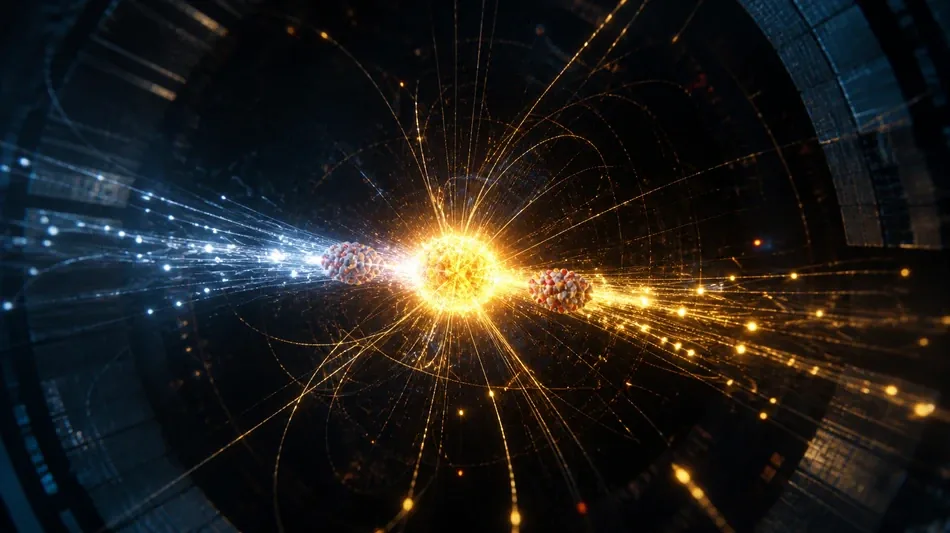
The smaller CERN collisions produced signals consistent with a tiny drop of material expanding collectively like a fluid before cooling into particles. Study co-author You Zhou of the Niels Bohr Institute said the experiment narrows the conditions under which matter can enter this state. Researchers are testing how far collision systems can be reduced while retaining fluid-like behaviour. Such experiments provide a laboratory route to studying primordial matter that no longer exists naturally in an accessible form.
P.Oliviero--LDdC