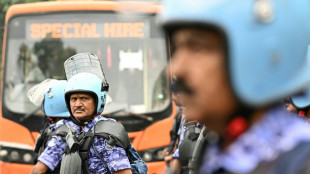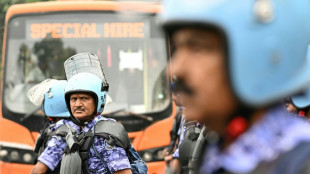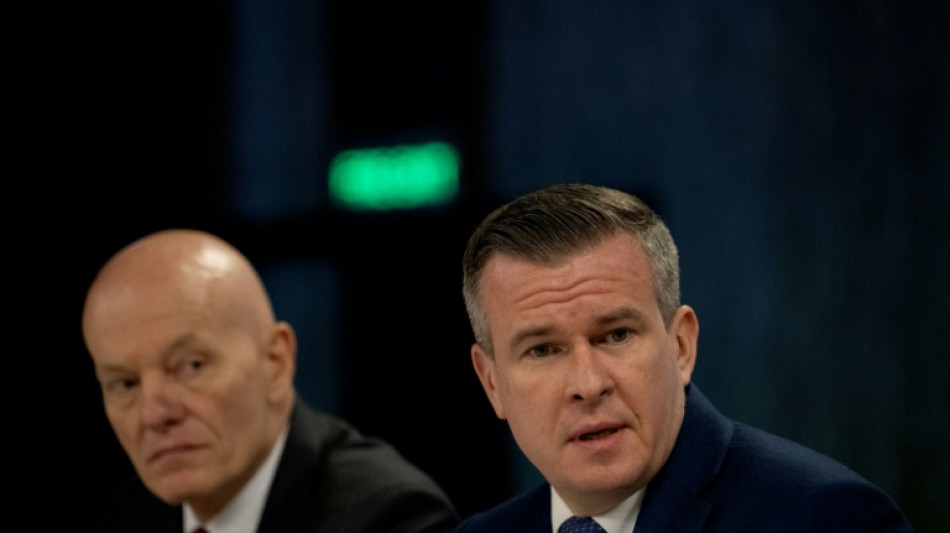
WADA targets India's performance-enhancing drugs production / Photo: Sajjad HUSSAIN - AFP
A crackdown on India's performance-enhancing drugs (PEDs) production -- the biggest globally -- is key to tackling the doping menace and protect the athletes, World Anti-Doping Agency (WADA) chief Witold Banka told AFP on Thursday.
Banka and his team have been in New Delhi as part of their push to build stronger ties with national law and order agencies including cyber crime cells to help uphold the credibility of professional sport.
WADA has sought help from India's Central Bureau of Investigation (CBI) -- federal police -- to curtail the initial supply chain of racketeers and agents who peddle drugs.
"We see the problem of production of performance-enhancing drugs (PEDs) -- India is the biggest producer of those illegal substances," said Banka.
"That's why we collaborate with CBI, with law enforcement, to try to destroy this market and to really protect the lives of athletes and the health of society," added the 41-year-old Pole.
WADA has been aggressive in curbing the doping crisis with their Global Anti-Doping Intelligence and Investigations Network (GAIIN) initiative since 2022.
An INTERPOL-backed "operation upstream" has been a success for WADA with 250 raids around the world, 88 illicit labs dismantled and almost 90 tons of PEDs seized.
"We are here because India is the biggest population (1.4 billion) and we see how important it is for the Indian authorities, and we see the need to strengthen the system here -- it's a common interest," Gunter Younger, head of investigations for WADA, told AFP.
"For now I see the appetite and willingness from the public authority side (in India) to work with us closely to address this issue. We know it's not only about the doping of the athletes."
- 'A big problem' -
Younger, a former head of the Bavarian Police's Cybercrime Division, said to strike a blow against the doping menace the focus should be shifted from athletes to the supplier of the PEDs.
"We always focus on testing, and the whole infrastructure in the last 25 years the anti-doping community was focusing on testing, and it was okay in the beginning.
"But the criminal networks, they adjust, and they adjust quite quickly.
"The fact that we have, let's say, under 1 percent hits with testing shows for me we can do better in this way.
"Therefore what we want to do with them is to strengthen their intelligence and investigations, working with the CBI, adopt a top-down strategy.
"Go for the criminal networks, and look for the clients, and target the coaches, the doctors that are responsible for providing the PEDs to the athletes, and not do a bottom-up strategy."
Not only is India the leader in manufacturing PEDs it also has the unwanted tag of topping the list of global sports drug cheats for three years in a row, the World Anti-Doping Agency (WADA) said in 2025.
India's National Anti-Doping Agency (NADA) collected 7,113 urine and blood samples out of which 260 tested positive in 2024, according to a WADA report published in December last year.
Pundits said it was a major blow to India, which is preparing to host the 2030 Commonwealth Games -- an event seen as a stepping stone for the country's ambition of hosting the 2036 Olympics.
But Banka said the figures have no bearing on India winning the right to host prestigious global sporting events.
"It's no doubt that there is a big problem with doping in India. The statistics show clearly the number of positive tests," he said.
"But I will be very concerned if year by year the number of positive tests go down significantly, then I think that maybe the National Anti-Doping Agency is not doing a good job."
Banka added, "It's not that if India maintains the first place when it comes to the number of positive tests, they will not be able to host the Games or World Championships.
"It's about how the system works from the legal perspective, and this is our role as a global anti-doping regulator to assess it."
A.Famiglietti--LDdC