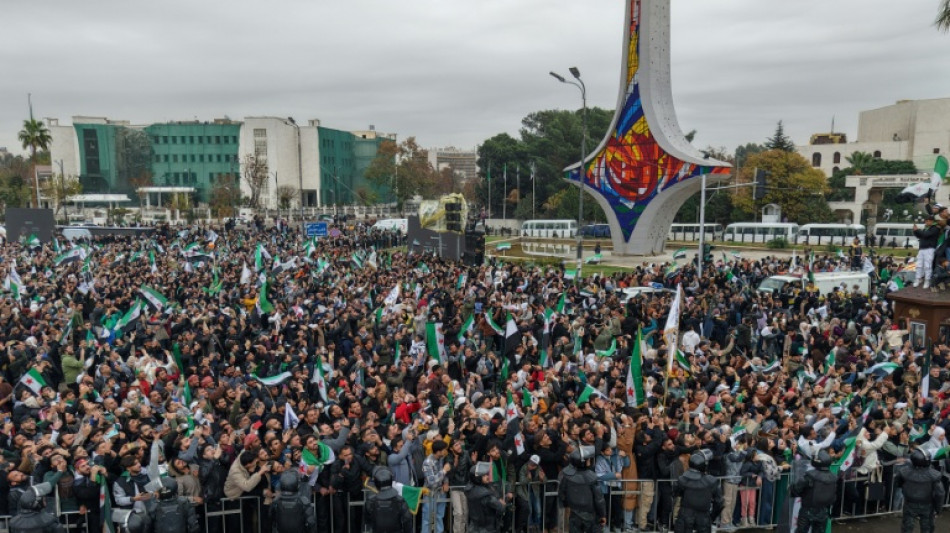
Syria's Sharaa vows to promote coexistence, reconciliation one year after Assad's ousting / Photo: Bakr ALKASEM - AFP
Syrian President Ahmed al-Sharaa vowed to usher in an era of justice and coexistence a year after the overthrow of Bashar al-Assad, with tens of thousands taking to the streets to mark the anniversary.
Sharaa's Islamist-led alliance launched a lightning offensive in late November last year and took Damascus on December 8, bringing a sudden end to more than five decades of Assad family rule and over a decade of civil war.
Jubilant crowds thronged the streets of the capital and other major cities, many people waving Syrian flags, AFP correspondents said, after mosques in the Old City began the day broadcasting celebratory prayers at dawn.
"Today, with the dawn of freedom, we declare a historic break with that legacy, a complete dismantling of the illusion of falsehood, and a permanent departure from the era of despotism and tyranny, ushering in a bright new dawn -- a dawn founded on justice, benevolence... and peaceful coexistence," Sharaa said in a speech to mark the occasion.
"We reaffirm our commitment to the principle of transitional justice to ensure accountability for all those who violated the law and committed crimes against the Syrian people," he added.
Multi-confessional Syria's fragile power transition has also been shaken by sectarian massacres in the country's Alawite coastal heartland and deadly clashes in Druze-majority Sweida in the south.
The authorities announced investigations after some government forces or allies were implicated in the violence.
The civil war, which erupted in 2011 with the Assad government's brutal crackdown on pro-democracy protests, killed more than half a million people and displaced millions from their homes.
Tens of thousands of people are still missing, many after disappearing into the former government's prisons, with families awaiting justice for Assad-era atrocities.
- 'Like a miracle' -
"What happened over the past year seems like a miracle," said Iyad Burghol, 44, a doctor, noting major developments including President Donald Trump's embrace of Sharaa, a former jihadist who once had a US bounty on his head.
After years of war and economic crisis, people need basics like electricity "but the most important thing to me is civil peace", Burghol told AFP.
Sharaa has made progress abroad like restoring Syria's international standing and winning sanctions relief, but he faces major challenges at home including gaining people's trust, guaranteeing security, rebuilding institutions and keeping his fractured country united.
"The current phase requires the unification of efforts by all citizens to build a strong Syria, consolidate its stability, safeguard its sovereignty, and achieve a future befitting the sacrifices of its people," Sharaa said following dawn prayers at Damascus's famous Umayyad Mosque.
He was wearing military garb as he did when he entered the capital a year ago.
Humanitarian worker Ghaith Tarbin, 50, expressed hope the government would now "prioritise civil peace" after years of war laid waste to swathes of the country.
- Challenges ahead -
In October, the World Bank said Syria's post-war reconstruction could cost up to $216 billion.
Syria's authorities have announced major investment deals including for infrastructure but most Syrians are yet to see major improvements.
Security remains a persistent problem, and critics have accused the new government of marginalising minorities and failing to protect them.
Some have called for decentralisation or self-determination, which Sharaa has staunchly opposed, insisting on a centralised state.
Amnesty International said "the new government's response to serious violations committed since they came to power... will be a litmus test of its commitment to pursuing justice and accountability".
Human Rights Watch said the authorities "have taken positive steps on justice, transparency, and rights but failed to prevent continued violence and atrocities".
In a statement, United Nations Secretary-General Antonio Guterres said that "what lies ahead is far more than a political transition; it is the chance to rebuild shattered communities and heal deep divisions" and forge a nation where all Syrians "can live securely, equally, and with dignity".
But not everybody was celebrating on Monday.
An AFP correspondent said shops were shut in and around the coastal city of Jableh, where a prominent Alawite spiritual leader had urged members of the religious minority -- to which the Assads belong -- to boycott the celebrations in protest against the new authorities.
In the country's Kurdish-held northeast, the authorities announced a ban on public gatherings on Monday, citing security concerns.
Under a deal agreed in March, the Kurdish administration was to integrate its institutions into the central government by year-end, but progress has stalled.
Israeli military operations and demands for a demilitarised zone in southern Syria are further challenges, despite ongoing negotiations between the two countries to address the security concerns of both sides.
burs-mam-lg/nad/dcp
S.dEsposito--LDdC