Karabakh rebels negotiate withdrawing their forces
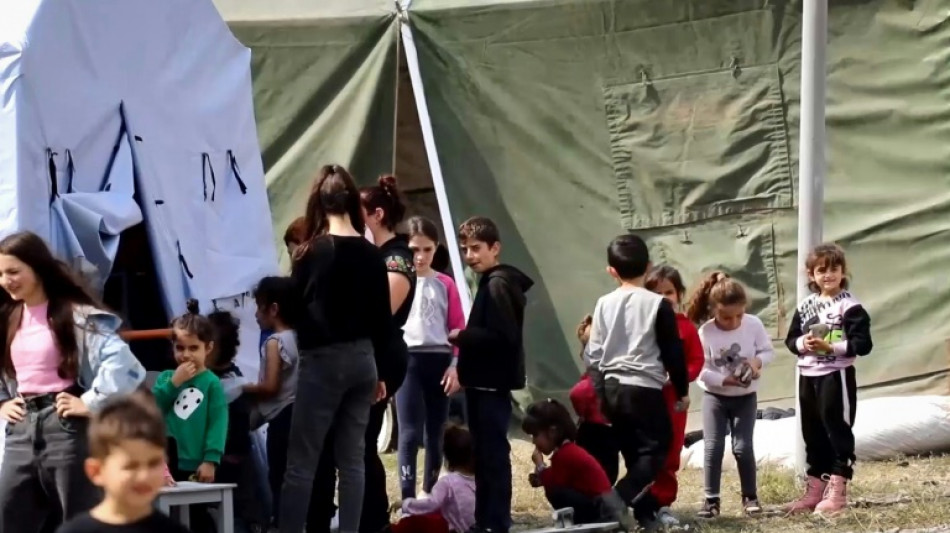
/ Photo: - - Russian Defence Ministry/AFP
Nagorno-Karabakh separatists said Friday they were negotiating the withdrawal of their troops from the disputed enclave after Azerbaijan reclaimed control in a lightning offensive.
Azerbaijan on Thursday held a first round of "reintegration" talks with the ethnic-Armenian rebels after they agreed to lay down their arms in the face of the day-long military assault.
The separatists said they were in talks with Baku to organise the withdrawal process and the return of civilians displaced by the fighting.
The announcement came after a spokeswoman for the breakaway region said Azerbaijan's forces were stationed on the outskirts of main city Stepanakert and the humanitarian situation was "horrible".
"Azerbaijani troops are all around the city, they are on the outskirts and people fear Azerbaijani soldiers could enter the city at any moment and start killings," spokeswoman Armine Hayrapetyan, based in Armenia's capital Yerevan, told AFP.
"People are hiding in basements."
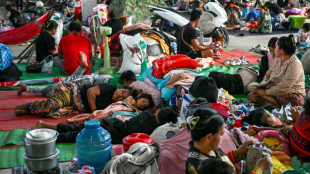
Civilians in the area -- estimated at up to 120,000 people -- report suffering from a shortage of electricity and basic utilities.
International pressure has mounted on Azerbaijan to re-open the the only road leading to Armenia, dubbed the Lachin Corridor, so that supplies and people can move in and out.
- 'I have no hope' -
Worried civilians were stuck on Friday hoping for access at the last checkpoint held by the Armenian army.
"I've been waiting for three days and three nights. I sleep in the car," said Garik Zakaryan, 28, who was trying to reach his family inside Karabakh.
"I have no hope," he told AFP.
The separatists said the sides were now discussing the procedure for citizens' entry to and exit from Nagorno-Karabakh.
Ahead of the latest flare-up, Azerbaijan had imposed a de facto nine-month blockage as it piled pressure on the region.
Baku said it had started sending in urgently needed aid on Friday as it seeks to cement its grip over the region that it lost control of in a war in the 1990s.
Hikmet Hajiyev, a foreign policy advisor to Azerbaijan's President Ilham Aliyev announced Baku had assured the International Committee of the Red Cross (ICRC) it could send in assistance.
He said the ICRC could collect wounded separatist fighters and ambulances were allowed come in from Armenia to carry out medical evacuations.
- 'Positive dynamics' -
Nagorno-Karabakh has been at the centre of more than three decades of conflict between Caucasus rivals Armenia and Azerbaijan since the Soviet Union collapsed.
The fighting has been marked by abuses on both sides and there are fears of a new refugee crisis among Nagorno-Karabakh's estimated 120,000 ethnic-Armenian residents.
Armenia's Prime Minister Nikol Pashinyan said the "situation remains tense" in the disputed territory despite the Russian-brokered truce deal largely sticking.
"There is a hope for some positive dynamics," Pashinyan told a cabinet meeting.
"I don't rule out that more humanitarian aid will be delivered to Nagorno-Karabakh... There are some agreements, they must start implementing these," he said.
Yerevan has said it does not foresee a large-scale influx of refugees for now, but is ready to receive 40,000 families if needed.
Azerbaijan said Thursday the first round of peace talks had been "constructive" and both sides expressed readiness for further negotiations.
- 'Nightmare' -
The surrender of the separatists, after an offensive they said left 200 dead, has sparked jubilation among Azerbaijanis.
But in Armenia, it ratcheted up pressure on Pashinyan, who has faced stinging criticism for making concessions to Azerbaijan since losing swathes of territory in a six-week war in 2020.
Hundreds of anti-government demonstrators blocked streets in Yerevan on Friday for a third day to protest the government's handling of the crisis.
"People must take to the streets, Karabakh needs us," Lida Mkrtchyan, 43, who comes from the region, told AFP.
"This is a nightmare we can't wake up from. Why aren't they opening a corridor so that people can leave?"
Opposition leaders have announced plans to initiate Pashinyan's removal by parliament.
The premier has called for calm after two days of scuffles between police and demonstrators, and vowed to act firmly against the rioters.
Pashinyan has blamed peacekeepers from traditional regional powerbroker Russia -- stationed around Karabakh since 2020 -- for failing to avert Azerbaijan's offensive.
Six Russian peacekeepers were among those killed in the violence, the Azerbaijan prosecutor's office said.
The Kremlin has said the dispute over which country Karabakh belongs to has now been settled and that conditions are in place to reach a lasting peace between Baku and Yerevan.
J.Padovano--LDdC