'We want new faces': Fed-up Guatemalans vote in tense runoff / Photo: Luis Acosta - AFP
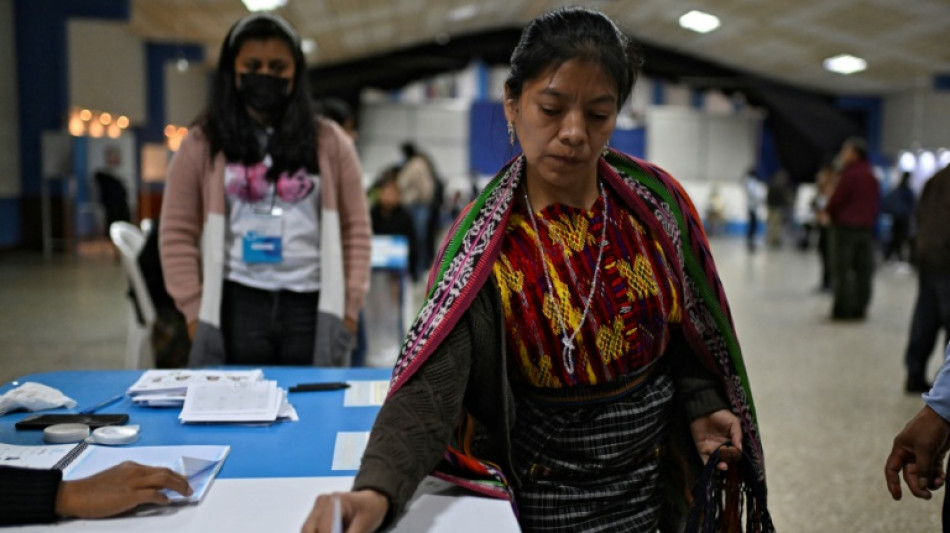
Guatemalans voted Sunday in a presidential runoff marred by efforts to disqualify a surprise frontrunner whose anti-corruption crusade has fired up voters and shaken those in power.
As polls closed and counting began, the focus turns to whether authorities will respect the outcome, after foreign allies raised the alarm about suspected meddling in the run-up to the vote against reformist candidate Bernardo Arevalo.
The outsider surged to the top of opinion polls after pulling off a massive upset in the first round, and his rival, the former first lady Sandra Torres, has already cried foul.
After a first round marked by low turnout and invalid votes, the TSE electoral body reported "a historic turnout percentage" at the close of voting, without giving details.
First results are expected late Sunday.
Fed-up voters expressed despair over the poverty, violence and corruption that have crippled the Central American nation, pushing thousands of its citizens to emigrate in search of a better life, many to the United States.
"You can no longer live anywhere, because there is so much crime," complained 66-year-old housewife Maria Rac, an Indigenous Mayan who voted in the town of San Juan Sacatepequez, 30 kilometers (20 miles) west of the capital.
Truck driver Efrain Boch, 47, voting in the same town, pleaded with the new government to tackle corruption.
Arevalo, the son of the country's first democratically elected president, Juan Jose Arevalo, has slammed the plague of corrupt politicians on the campaign trail.
"We are sure that the winners will be the people of Guatemala," Arevalo said after voting in the capital.
Observers fear authorities will attempt to undermine the vote, following efforts by a top prosecutor to have Arevalo disqualified, citing irregularities in how his Semilla party was formed.
Raids were also carried out at Semilla offices and those of electoral officials.
The prosecutor Rafael Curruchiche -- sanctioned by Washington for corruption -- said he did not rule out more raids and possible arrests after the elections.
- A 'risk' to the system -
At the close of voting, the TSE reported no "significant incidents" during the day.
Torres, from a traditionally central left party, has promised welfare programs and various subsidies for the poor.
However, she has also won the backing of the right and evangelicals, has increased her socially conservative rhetoric, and is seen as representing the establishment.
"Traditional political forces have bet on Torres, because Arevalo is seen as a risk to the continuity of the system," political analyst Arturo Matute told AFP.
Mayan farmer Brigido Chavix, 57, said he did not support Arevalo, "but I voted for him because we want new faces."
"That lady (Torres) has already been around for a long time talking about policies, policies, and she has never carried them out."
Torres, 67, is the ex-wife of late leftist president Alvaro Colom, with the pair divorcing so she could circumvent laws preventing her from seeking office in 2011.
The Supreme Court banned her anyway, but she ran and came second in 2015 and 2019.
On Sunday she denounced "some irregularities" during voting, without giving evidence.
Before the election, she raised doubts about the objectivity of the country's electoral board, accusing it of leaning toward Arevalo's party.
She has dismissed Arevalo as a "foreigner" because he was born in Uruguay while his father was in exile.
"We cannot allow Guatemala to fall into the hands of radicals," she said recently, in a jab at Arevalo. "We cannot permit Guatemala to become a Venezuela or a Cuba."
- 'Corrupt' taken control -
The winner will replace unpopular right-wing President Alejandro Giammattei, who is constitutionally limited to one term.
Under Giammattei, several prosecutors fighting graft have been arrested or forced into exile. He has also cracked down on critical journalists.
The corrupt "have progressively taken control of all state institutions," former attorney general Claudia Paz y Paz -- who is now in Costa Rica -- told AFP.
Guatemala has some of the worst poverty, malnutrition and child mortality rates in Latin America, according to the World Bank.
burs-fb/nro
M.Magrino--LDdC