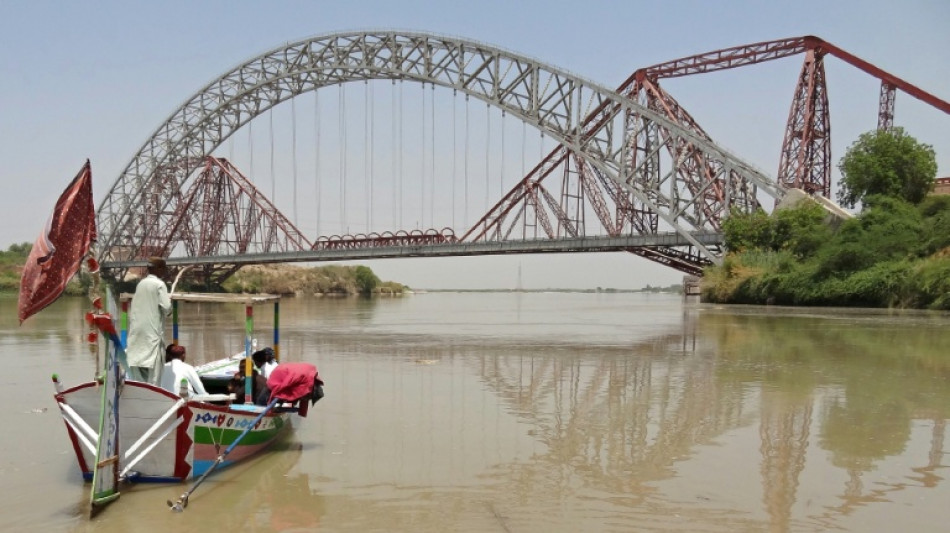
Tribunal says India cannot withdraw from water treaty with Pakistan / Photo: Shahid ALI - AFP
An international tribunal ordered India on Monday to "observe its obligations" under a treaty with Pakistan on the sharing of the Indus and other rivers, which the New Delhi government sought to suspend.
The Permanent Court of Arbitration, based in The Hague in the Netherlands, also made an order "prohibiting" India from carrying out works at two hydroelectric projects that could breach the 1960 Indus Water Treaty.
The treaty governs the use of water from six rivers, whose headwaters originate in India but flow into Pakistan as part of the Indus basin -- a resource relied on by hundreds of millions.
The Indus cuts through ultra-sensitive demarcation lines between India and Pakistan in contested, Muslim-majority Kashmir -- a Himalayan territory both countries claim in full.
India said in May 2025 that it was suspending its membership of the treaty after accusing Islamabad of backing a deadly attack on tourists on the Indian side of Kashmir. Pakistan denied the charges.
New Delhi immediately rejected the court's decision on Monday that India had no grounds to withdraw from the treaty.
"India categorically rejects its so-called award, just as it has firmly rejected all prior pronouncements by this illegally constituted body," the foreign ministry said in a statement.
"India's decision to hold the Indus Waters Treaty in abeyance remains in force."
Pakistan welcomed the tribunal's decision, as well as interim measures imposed by the court requiring India to pause work on a dam wall for a hydroelectric project and provide regular construction updates until an expert gives a final ruling expected next year.
Deputy Prime Minister and Foreign Minister Ishaq Dar added on X that the decision "vindicates Pakistan's consistent position that a binding international treaty cannot be unilaterally suspended or set aside".
He said his nation was committed to protecting it rights under the treaty.
- 'Not a single drop' -
India's Water Minister C.R. Patil said this year that the government would ensure that "not a single drop of water" will flow into Pakistan, which accused India of seeking to "weaponise" the precious resource.
Pakistan has previously said it would consider any attempt to change the flow of cross-border waterways as an "act of war".
The court said in a statement that it had unanimously found that "none of the grounds" put forward by India to suspend the treaty were justified.
It said India's construction of hydroelectric projects on the Indus and associated rivers had to conform to the 1960 treaty.
"In a unanimous decision, the court found that none of these grounds could justify suspension or termination of the treaty," a statement released by the panel said.
"Accordingly, the Indus Waters Treaty remains fully in force, and India must observe its obligations under the treaty, including those relating to the design and operation of its hydro-electric projects on the Western Rivers," it added.
Water risks becoming a flashpoint in a region grappling with climate change and population growth, which are stretching resources in the agricultural sectors that form the backbone of both countries' economies, experts say.
The water treaty provided a rare avenue of diplomatic engagement between the rival sides until India suspended its involvement.
burs-grk/je/lga
F.dGiugiaro--LDdC