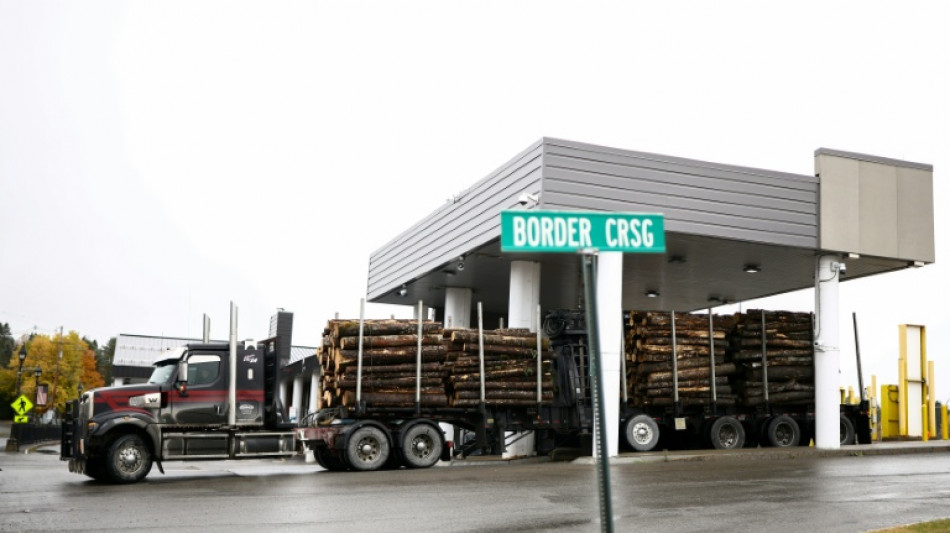
Maine logging, cross-border ties whipsawed by US-Canada tariff war / Photo: CHARLY TRIBALLEAU - AFP
In the heat of US midterm elections, President Donald Trump's tariffs on Canada -- and Ottawa's retaliation -- have taken center stage in timber-producing Maine, walloped by the economic fallout perhaps more than any other state.
Residents in Maine's frontier towns express worry that the tariffs have also triggered a rupture in cross-border relationships built up over decades, and that the intricate community fabric could take years to repair.
"Tariffs are definitely, economically, going to hurt us here" in northern Maine, brewery co-owner Shawn Pelletier said in Caribou, a city with extensive ties to Canada's New Brunswick province.
Maine is reluctantly on the front lines of the trade war which saw Trump last year slap tariffs of up to 50 percent on some Canadian goods, including logging equipment and some wood products.
Many logging operations in the nation's most heavily-forested state are suffering, and cross-border tourism has tanked. Households already struggling with fuel prices are seeing costs of living soar, an issue dominating the midterms.
Ahead of the November 3 vote to decide who controls the US Congress, tensions are up in the port-of-entry town of Fort Kent and Maine's other border stations where two million Americans and Canadians cross every year.
"We're worried they hate us," a Maine retiree sitting with friends told AFP in Fort Kent, as she nodded towards Canada, visible across the Saint John River.
- 'Ripple' effect -
Figures show the economic pain has already arrived and is "far-reaching," according to Garrett Martin, president of the nonpartisan Maine Center for Economic Policy (MECEP).
Because Maine shares "a long history with Canada, and intertwined both family and business relationships, I think there are a lot of ways in which we are potentially being hurt even more" by the tariff impact, Martin told AFP.
Canadian visits to Maine plunged 43 percent in the tariffs' first year, depressing shop sales and tax revenue, he said.
And in Maine's $8-billion forest-related industry, "we're seeing cost increases ripple through," with some logging operations shrinking or shuttering altogether, Martin said.
Logging has been in a slump for years, with eight pulp and paper mills closing in Maine since 2012, according to Dana Doran, executive director of the Professional Logging Contractors of the Northeast (PLC).
Now tariffs on trucks, logging equipment, parts and wood products are sending prices "up 30 to 50 percent across the board," Doran told AFP.
High diesel costs have only darkened the scenario.
- 'Friction' -
For two centuries, Canadian mills near Maine have processed vast amounts of its timber.
The border communities are linked through business and families, but "the tariff conversation I think has added friction to that situation, which is unfortunate," Doran said.
Canada, by far Maine's top trading partner, retaliated against Washington in September with tariffs of 25-50 percent on US lumber, wood furniture and more.
Maine-based companies, particularly producers of hardwood, "rely heavily on those Canadian markets," Doran said.
Not all Maine loggers are upset. Pleasant River Lumber Company is producing 110 million board feet of softwood lumber per year at its main sawmill in Enfield and aims to expand production.
In a forest grove to the east, a contractor climbed into a mechanical harvester and pivoted its head to grip and fell a tree, strip its branches and cut the trunk into exact lengths.
"The margins are so thin that you can't make a lot of mistakes," a logging manager said.
On a tour of the highly-automated sawmill, co-owner Jason Brochu told AFP that US tariffs and duties have created a level playing field to compete with Canada's subsidized lumber operations.
"We're a glaring example of how trade protection works and how it's beneficial," said Brochu.
Either way, the trade war is causing political headaches.
Trump on Friday announced a tariff pause for Canadian wood products and some other imports, a last-minute move critics interpreted as seeking to aid Republicans in tight midterm races.
In a scrappy battle for a US Senate seat, Maine incumbent Susan Collins sought to take credit for securing those exemptions.
Her Democratic challenger Troy Jackson, himself a former logger, argued Collins merely "enabled this chaos" brought by Trump's tariffs.
How long such instability lasts is unknown.
"It's going to take a long time to rebuild the trust" between Mainers and Canadians, said the MECEP's Garrett.
A.Falconi--LDdC