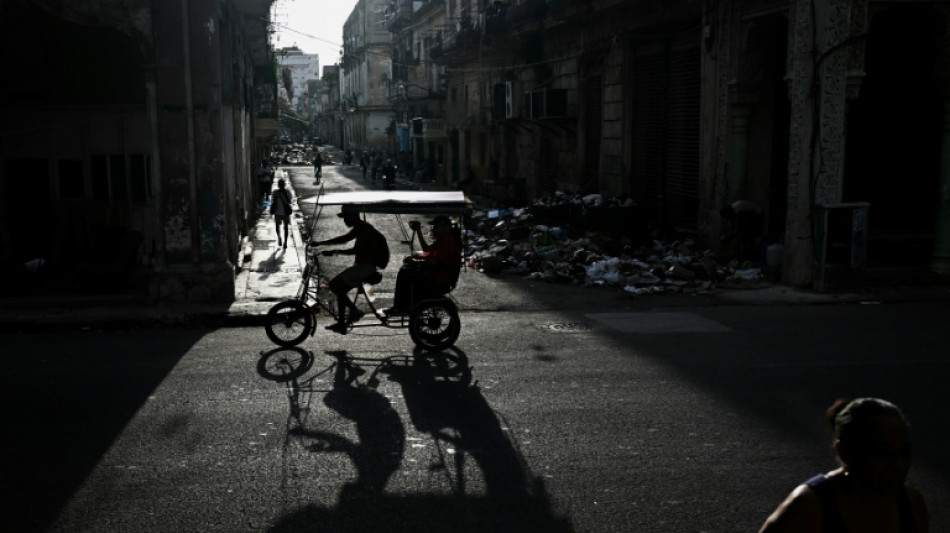
Cuba works to restore power after another blackout / Photo: YAMIL LAGE - AFP
Cuba worked Saturday to restore power after its seventh major blackout of the year, as the communist-run island grappled with woes triggered by a US fuel blockade.
This latest nationwide outage, the 12th since late 2024, occurred after a failure in transmission lines paired with "unstable weather conditions," state-run utility UNE said Friday.
The blackout first hit five provinces in eastern Cuba, including Havana, and then spread to the rest of the country.
UNE said 48 percent of its customers in Havana had regained power on Saturday.
"The re-establishing is being done gradually, as conditions permit," it said on X.
In the last blackout in early August it took the company 36 hours to get the lights back on fully.
The island of over nine million people endures constant power cuts due to the poor state of its aging thermoelectric plants.
But the situation has worsened significantly since January, when Washington imposed a de facto energy blockade on the island in a bid to pressure Havana's communist government.
A severe lack of fuel makes it difficult to supply Cuba's power plants and backup generators, which typically run on imported diesel.
"It's one thing after another: no water, no gas for cooking, no electricity," schoolteacher Lidia Fernandez, who was just finishing up her workday, told AFP on Friday.
"Honestly, I don't know how we haven't gone crazy," the visibly irritated 36-year-old added.
In recent weeks, blackouts have lasted more than 30 hours in the capital, while in outlying provinces, they have sometimes stretched past 60 hours.
The cuts have also affected the island's water supply and mobile phone network, and general living conditions are extremely tough for residents.
Havana blames the crisis on an array of US-imposed punitive measures, while Washington attributes the hardship to poor internal management.
An economic crisis has engulfed the Caribbean island, where 66 percent of the population lives in poverty, according to an independent study released this week.
That is compared to 45 percent in mid-2025, with rising food costs behind the sharp increase in poverty, the research by the Christian Center for Reflection and Dialogue (CCRD) suggests.
The findings give "an indicative picture that the problem is growing," study coordinator Mayra Espina told AFP.
Another retiree, Zunilda Garcia, took the latest blackout in stride, stepping outside to charge a small lamp with solar energy.
"We have to wait and stay calm," Garcia, 60, said. "We can't lose hope."
F.Abate--LDdC