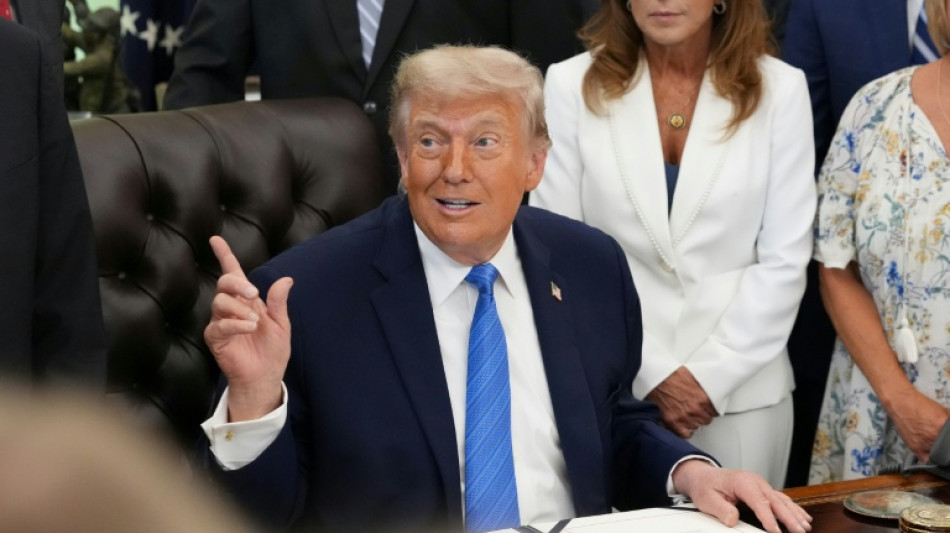
"I love the inflation": Trump comment on latest price jump sparks backlash / Photo: Ken Cedeno - AFP
US President Donald Trump on Wednesday brushed off concerns about consumer inflation surging to a fresh three-year high in May, on the back of soaring energy prices caused by his war in Iran.
"The numbers were great... I love the inflation," Trump told reporters, a comment pounced on by Democrats who have made rising prices a cornerstone of their campaign to take control of Congress in November's midterm elections.
The consumer price index (CPI) rose 4.2 percent year-on-year, up from the previous month's 3.8 percent figure and the highest reading since April 2023.
The Republican Speaker of the House Mike Johnson later argued that the president's remarks had been taken out of context, but Senate Democratic Minority Leader Chuck Schumer said they demonstrated Trump's disdain for the financial struggles faced by American families.
"Trump really said, 'I love the inflation.' On camera. For all of America to hear. His contempt for you knows no bounds," Schumer posted on X.
And the Democratic Party posted a new campaign ad on its social media account featuring a video of Trump's comments.
"Trump said the quiet part out loud -- he loves inflation. Every American should see this," the post said.
The US-Israel war against Iran, launched in late February, has sent energy prices skyrocketing after Tehran retaliated by virtually closing the vital Strait of Hormuz, through which roughly a fifth of global oil and gas normally pass.
Trump also repeated his prediction that inflation would "come down like a rock" after the conflict ends.
Economists have disputed that claim, with oil prices expected to take months to return to pre-war levels, depending on when hostilities end.
- Possible peak -
May's consumer inflation data showed energy prices had risen 23.5 percent over the same time last year, with gasoline rising by 40.5 percent.
Grocery prices also rose significantly for the second month in a row, up 2.7 percent over a year ago.
Other prices to increase over the month included medical care, personal care, airline fares and recreation.
Americans have been dealing with years of higher prices, with inflation remaining elevated long after the Covid pandemic.
Prices have been fuelled by repeated shocks, including the Russian invasion of Ukraine, Trump's tariffs and now the war on Iran.
Analysts, however, said that gasoline prices at the pump have recently stabilized, potentially indicating a favorable outlook for overall inflation.
"Higher energy prices again pushed up inflation last month, but we estimate that inflation has peaked and will trend lower in the second half of the year," said Kathy Bostjancic, chief economist at Nationwide.
She added that this was assuming there was a "near-term resolution with Iran to reopen the Strait of Hormuz."
Core CPI inflation, which excludes volatile food and energy prices, came in at 2.9 percent in May, up from 2.8 percent the month before.
"For now, there appears to be little passthrough of higher energy cost onto core inflation, outside of airfare," said Gregory Daco, chief economist at EY-Parthenon.
- 'No position to cut rates' -
The US Federal Reserve has a long-term two-percent target for inflation, and the central bank's key interest rate-setting committee will meet next week.
It will be new chairman Kevin Warsh's first meeting since taking office last month, and he will be under pressure from Trump to reduce interest rates.
Markets, however, expect the Fed to keep rates steady at this meeting, and are now pricing in rate hikes for later in the year, spooking equity investors.
Before the war, markets had priced in rate cuts for later in the year, with expectations that inflation fueled by Trump's tariff policy would begin to fade.
The war, however, has complicated the outlook, with more Fed policymakers saying they were concerned about rising inflation, which the central bank would typically address by raising rates.
"The Fed will be in no position to cut rates if this continues," said Chris Zaccarelli, chief investment officer for Northlight Asset Management.
A.Dodaro--LDdC